
Table of Contents
ToggleModern buildings are packed with thousands of parts that need constant eyes on them. Most facility teams are stuck battling old drawings and missing records, which is exactly why Scan to BIM for Facility Management has become such a game-changer for keeping building data accurate.
Laser scanners grab every detail of a physical structure and turn it into a digital model. Once that data is organized into a proper BIM, your team finally has a reliable digital space to run things. Mixing laser scans with BIM modeling is the real secret to smoother operations across the whole building lifecycle.
From hospitals to commercial office towers, the rush for Scan to BIM Services for Facility Management is only picking up speed. Building pros are moving away from dusty paper drawings and leaning hard into data-driven management.
Understanding the Concept of Scan to BIM for Facility Management
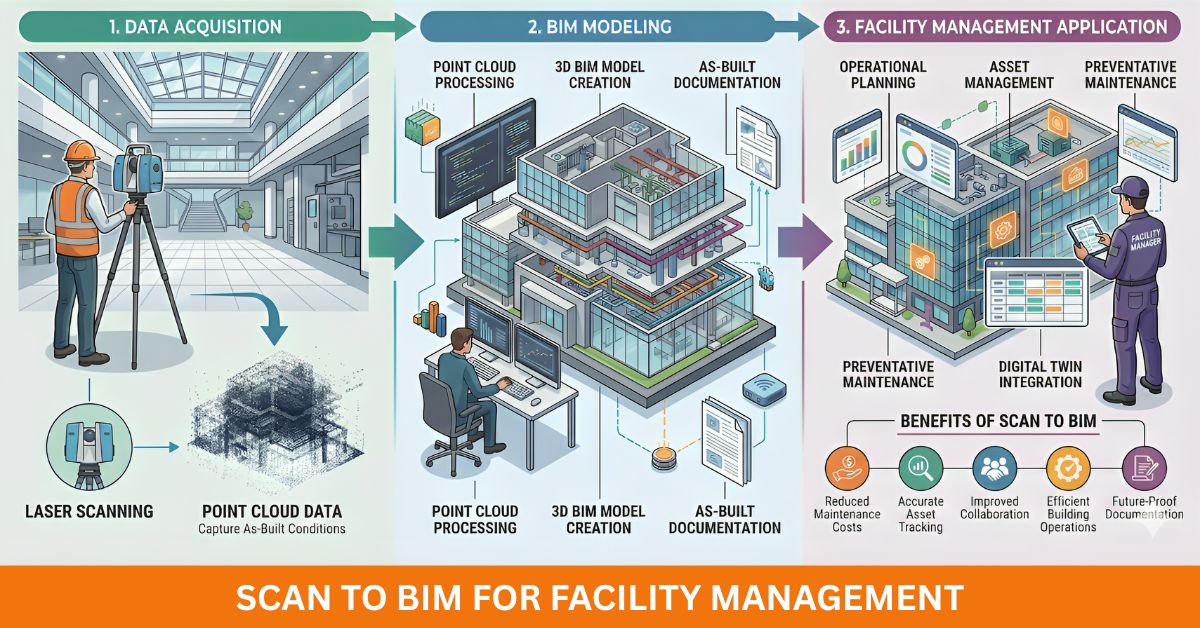
Simply put, Scan to BIM for Facility Management is about using 3D scanners to map a building and turning that “point cloud” into a smart model. You end up with a digital version of every wall, pipe, and piece of gear on-site.
This approach backs up your long-term BIM for building lifecycle management, giving managers the actual facts on their assets for the life of the building.
The approach typically includes:
- Laser scanning of existing buildings
- Processing point cloud data
- Creating as-built BIM models for facility management
- Integrating asset information into the model
- Using BIM platforms for maintenance and operations
Using Scan to BIM for building documentation is way more reliable than old CAD files, which usually end up being useless after the first few renos or plant upgrades.
How the Scan to BIM Facility Management Workflow Works
The scan to BIM facility management workflow is a tight digital process built specifically to turn physical buildings into accurate models for your day-to-day operations.
1. Laser Scanning of the Facility
High-precision laser scanners capture millions of measurement points from the building environment. This data creates a detailed spatial record known as a point cloud.
2. Processing Point Cloud Data
That captured data is the core of point cloud to BIM for facility management, where we clean up and organize the raw scan data into something your team can actually use.
3. Creation of As-Built BIM Models
Expert modelers then turn those clouds into as-built BIM models for facility management, mapping out everything from the architecture to the complex MEP systems.
4. Asset Information Integration
Once modelling is complete, building components receive asset information such as equipment IDs, maintenance schedules, warranty details, and performance data. This stage supports scan to BIM for asset management and long-term building maintenance.
5. Facility Management Platform Integration
These models plug right into your software, letting your crew handle repairs, checks, and planning through a purely digital setup.
Why Buildings Are Adopting Scan to BIM for Facility Management
Managers all over the world are turning to Scan to BIM for Facility Management because buildings are just getting too complex. Having the right digital info makes maintenance and safety compliance a whole lot simpler.
Older buildings often lack reliable construction drawings. Renovations and system upgrades make documentation even more inconsistent. Using point cloud to BIM for facility management, building conditions can be captured accurately without relying on outdated plans.
You’ll find property managers using scan to BIM solutions for facility managers to keep things running smoothly, especially on huge campuses or high-rise towers.
Benefits of Scan to BIM for Facility Management
There are some massive wins that make Scan to BIM for Facility Management a “must-have” for modern building ops.
Accurate Building Documentation
Laser scans nail the exact measurements of a site. The models you get out of it give you a solid scan to BIM for building documentation that kills any guesswork caused by missing drawings.
By implementing advanced scanning workflows, organizations not only improve operational efficiency but also gain better visibility into Scan to BIM Cost, helping stakeholders make informed investment decisions for facility upgrades.
Efficient Building Maintenance
Maintenance crews get a huge boost from scan to BIM for building maintenance. They can see exactly where equipment sits and how to get to it in the model, which makes planning a breeze.
Improved Asset Management
With scan to BIM for asset management, you can link every part of the building to live data. It makes tracking life cycles and replacement dates much easier.
Better Facility Planning
Facility managers can visualise building systems and spaces before making operational decisions. This improves space planning, renovation planning, and infrastructure upgrades.
Support for Digital Twin Systems
BIM models generated through Scan to BIM for Facility Management can serve as the foundation for a digital twin for facility management, where real-time operational data connects with the digital building model.
Key Components of BIM Models Used in Facility Management
Facility management BIM models typically contain several categories of building information that support operational decision-making.
| BIM Component | Purpose in Facility Management |
|---|---|
| Architectural Model | Displays walls, floors, rooms, and building layout |
| Structural Model | Represents beams, columns, slabs, and load systems |
| MEP Systems | Includes HVAC, electrical networks, and plumbing systems |
| Asset Data | Stores equipment details and maintenance schedules |
| Space Management Data | Tracks occupancy and space utilisation |
These integrated components form the core structure of building information modeling for facility managers.
Scan to BIM for Building Operations and Maintenance
Effective building operations depend on accurate spatial information. Scan to BIM for building operations provides facility managers with clear digital visibility of building infrastructure.
Maintenance planning becomes easier when service routes, equipment clearances, and system connections are visible in the BIM model. Instead of relying on manual inspection records, facility teams can access digital models that represent real building conditions. This capability significantly improves how scan to BIM helps facility managers make informed operational decisions.
The adoption of Scan to BIM for Facility Management also supports compliance documentation, safety planning, and equipment inspection processes.
In addition, authoritative industry resources such as the buildingSMART international BIM standards platform highlight how BIM data improves lifecycle management and digital asset tracking.
Role of Digital Twins in Modern Facility Management
Building a digital twin for facility management takes your BIM model to the next level by hooking it up to real-time data from your building systems.
Smart sensors feed info directly into the model, giving you a live view of how the building is actually performing. This lets your team keep an eye on energy use and system health on the fly.
When paired with Scan to BIM for Facility Management, digital twins create a powerful operational environment in which building data is continuously updated. This integration supports BIM for building lifecycle management, improving sustainability and operational planning throughout the facility’s life.
Scan to BIM for Infrastructure and Large Facilities
Large infrastructure projects such as airports, transport hubs, hospitals, and universities require precise digital documentation. In these high-stakes setups, scan to BIM for infrastructure management becomes worth its weight in gold.
Infrastructure has some massive, complex networks. Laser scanning lets us map those environments perfectly, and BIM modeling turns that mess of data into a model you can actually manage.
For big sites, professional scan to BIM modeling services are the only way to ensure your data stays consistent across every property you manage. Plenty of firms now outsource scan to BIM services to specialists who really know the ins and outs of point cloud processing and global BIM standards.
Choosing Professional Scan to BIM Experts for Building Management
Choosing the right Scan to BIM experts for building management is the key factor in whether your project succeeds.
Professional scans to BIM experts for building management typically follow recognised BIM standards, ensuring accurate modelling, structured asset data, and compatibility with facility management platforms.
Important factors when selecting providers include:
- Experience with point cloud to BIM for facility management
- Capability to produce as-built BIM models for facility management
- Understanding of the scan to BIM for infrastructure management
- Ability to integrate asset data for facility operations
Working with specialised providers ensures that scan to BIM solutions for facility managers deliver long-term operational value rather than simple 3D visualisations.
Conclusion
The future of building operations increasingly relies on digital building intelligence. Scan to BIM for Facility Management provides facility teams with accurate building data, structured asset information, and reliable operational insights.
Through the scan to BIM facility management workflow, buildings are captured, modelled, and transformed into intelligent digital systems. These models are what drive your maintenance, asset tracking, and future upgrades.
As buildings get smarter, Scan to BIM for Facility Management stays at the heart of how we run them. Integrating a digital twin for facility management and scan to BIM for building maintenance ensures your data stays useful for years.
Organisations seeking reliable building data can benefit from professional scanning to BIM modeling services delivered by experienced specialists. Accurate building documentation, efficient maintenance planning, and streamlined operations become achievable when digital building intelligence replaces outdated documentation systems.
Get in touch or grab a quote to see how our Scan to BIM solutions for facility managers can help you unlock the real power of digital management.
Frequently Asked Questions
What is Scan to BIM for Facility Management?
Scan to BIM for Facility Management turns laser data into detailed models that handle your maintenance, asset tracking, and ops for the life of the building.
How does the point cloud to BIM support facility management?
Point cloud to BIM for facility management takes raw scan data and builds it into models that help your team manage assets and maintenance without the errors.
Why are as-built BIM models important for facility management?
As-built BIM models for facility management give you an exact digital copy of your building, so the maintenance crew always knows where every pipe and wire actually is.
How does Scan to BIM help facility managers manage assets?
Scan to BIM for asset management connects building components with operational data such as service history, warranties, and replacement schedules, improving asset lifecycle planning.
What industries use Scan to BIM for building operations?
Sectors like healthcare and commercial real estate are big on Scan to BIM for building operations to boost their maintenance and overall building performance.
Can Scan to BIM support digital twin facility management systems?
Absolutely. Scan to BIM for Facility Management provides the high-accuracy model you need to run a digital twin for real-time monitoring.