Table of Contents
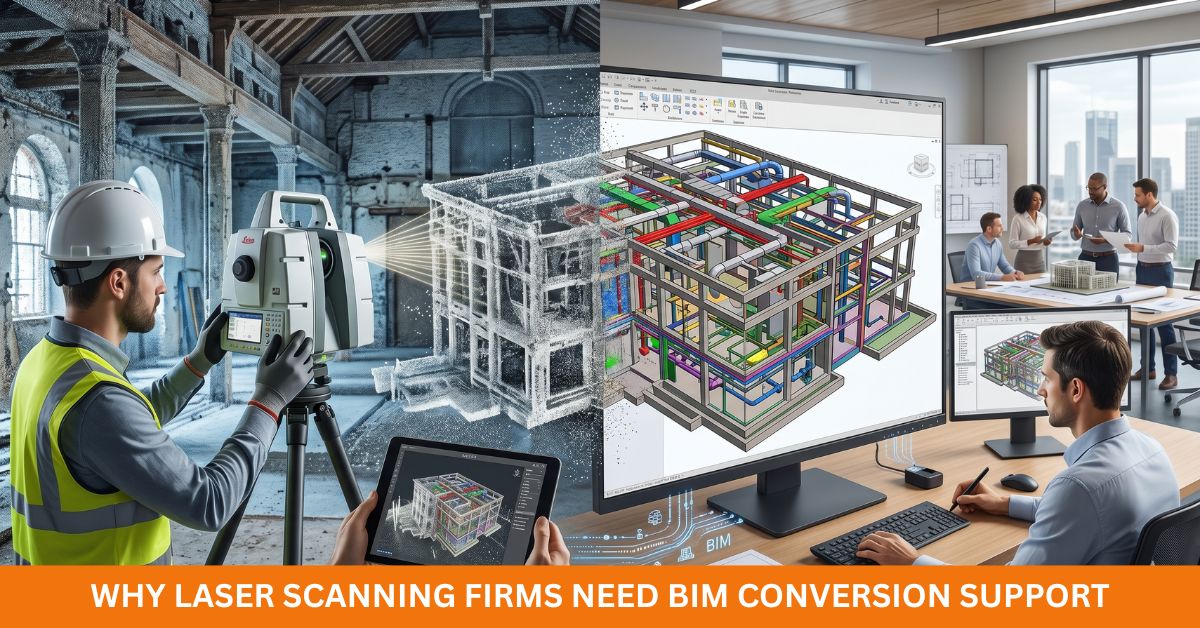
ToggleLaser scanning teams are great at capturing reality with high precision, but raw scan data by itself doesn’t give you the full value of a project. That gap is what usually slows things down and makes the data hard to work with. This is why BIM Conversion Support is so vital; it turns those messy point clouds into smart models that your team can actually put to work.
As jobs get more complicated, the need for structured data goes through the roof. Because of that, firms are looking for faster ways to turn their raw scan data into BIM outputs they can actually use.
Plus, clients are asking for faster turnarounds and better accuracy than ever before. The old-fashioned methods just don’t cut it anymore, while BIM-based workflows make it easy to coordinate and really slash the number of errors.
As a result, firms using Scan to BIM Conversion Support stay competitive and scalable. In today’s digital construction environment, integration between scanning and BIM is no longer optional. It is a strategic necessity.
The Gap Between Scan Data and Usable BIM Models
Laser scanning produces dense point cloud datasets. The problem is these datasets don’t have any structure or “smarts” to them, which creates a lot of headaches during the design and build phases.
For instance, laser scan to BIM processes take that raw data and build it into a structured model. This gives you clear geometry, categorized objects, and parts you can actually measure. Without this step, point cloud modeling services are basically unfinished.
Also, point cloud to BIM conversion makes the data much more useful for everyone involved. Architects, engineers, and builders all need clean models to work from, so registering scan data to BIM is a huge deal for keeping everyone coordinated.
Plus, a solid scan to BIM workflow ensures everything stays consistent and hits the right standards. It organizes your data into formats like Revit models so the entire team is on the same page and the work flows better.
How BIM Conversion Support Enhances Accuracy
Winning in construction really comes down to accuracy; even a small mistake can snowball into a total disaster later. That is why BIM Conversion Support is so vital for keeping those project risks as low as possible.
Point cloud cleanup and modeling strip away the noise and errors from your scans, ensuring the final output is high-precision. It’s the same with using specific techniques for scan to BIM accuracy improvement; it just makes everything more reliable from start to finish.
You also get a massive boost in efficiency. Using scan to Revit modeling really kicks the design phase into high gear by getting rid of manual drafting and letting you make calls much faster. Plus, a good scan to BIM data processing setup streamlines the whole workflow for quicker delivery.
Another big win is the scan to BIM LOD 300 400 development. When you have that higher level of detail, your visualization and documentation are much better, giving the team more insight and control over the job.
Key Benefits of BIM Conversion Support for Laser Scanning Firms
There are plenty of reasons why BIM Conversion Support is a smart move, as it hits both your project quality and your bottom line.
- Improved coordination through scan to BIM coordination models
- Better design validation using scan to BIM clash detection
- Enhanced deliverables with laser scan to BIM deliverables
- Faster turnaround with scan to BIM outsourcing
- Scalable solutions through scan to BIM modeling services
Also, things like LiDAR scan to BIM and terrestrial laser scanning to BIM give you a lot of flexibility. These techs work for anything from a small home renovation to a massive infrastructure project.
Getting an as-built BIM from laser scans makes your documentation much more accurate. It creates a solid record for the future, so long-term maintenance is way easier to manage.
Role of BIM in Modern Construction and Design
Modern building is all about digital workflows, with BIM sitting at the center of how we plan and collaborate. That is why getting your laser scan data into Revit and BIM is a must-have.
Using scan to BIM for architects makes it much easier to visualize a design and plan out spaces. Likewise, scan to BIM for construction helps coordinate the site better and stops you from having to do the same work twice.
Also, scan to BIM integration services are great for bridging the gap between various teams, ensuring that talking and sharing data is as easy as it can be.
Refer to this resource BIM processes, for a deeper understanding. Also, using point cloud segmentation BIM helps you chop up complex data into bits you can actually manage. It makes the modeling easier and clearer, and in the end, BIM Conversion Support ensures your scans meet the industry standards people expect.
Workflow Optimization with BIM Conversion Support
A successful project is only as good as its workflow, so optimizing your scan to BIM project workflow is key. Turning your laser scan data to Revit lets it sit perfectly inside your design tools, so you aren’t doing the same work twice.
Using a laser scan mesh to BIM ensures your geometry is spot on, while point cloud to Revit services help you turn raw data into smart elements fast. It saves the whole team a ton of time. Don’t forget about scan to BIM documentation either; it makes everything more transparent and holds everyone accountable.
Working with a professional scan to BIM conversion company gives you the expertise and the scale you need to handle massive amounts of data without breaking a sweat.
Traditional Workflow vs BIM-Driven Workflow
| Aspect | CAD to BIM | BIM Conversion Support Workflow |
|---|---|---|
| Data Usage | Limited | Fully integrated |
| Accuracy | Moderate | High precision |
| Speed | Slow | Faster delivery |
| Coordination | Fragmented | Centralized |
| Scalability | Low | High |
Looking at it this way, the perks of BIM Conversion Support are obvious, it just makes everything perform better.
Future Trends in Scan to BIM Technology
Technology continues to evolve rapidly. Therefore, scan to BIM workflows also adapt to new trends. Automation is beginning to handle more of the point cloud to BIM conversion, which gets rid of the boring manual grunt work and speeds things up. AI is also jumping in to help with point cloud cleanup and modeling accuracy.
Cloud platforms are making it way easier for teams to collaborate from basically anywhere, which makes managing a global project much less of a headache.
We are also seeing a lot more demand for scan to BIM outsourcing. Companies want a way to save money without losing any quality in their models. These trends indicate a strong future for BIM Conversion Support in the industry.
Conclusion
Laser scanning firms operate in a highly competitive environment. Therefore, adopting BIM Conversion Support becomes a strategic move. It basically takes your raw data and turns it into useful models and insights.
Plus, it boosts your accuracy and helps everyone work together better. That is what leads to a successful project and happy clients. As things move forward, everyone is going to be relying on BIM, so the firms that get on board now will have the edge.
Get a cost estimation for your Laser scan to BIM workflows and your projects on track. Get in touch now to see what your laser scan data can really do with some expert BIM conversion help.
Frequently Asked Questions
Why is the laser scan to BIM important?
Laser scan to BIM converts point cloud data into intelligent models. It enhances design clarity and supports better decision-making.
How does point cloud to BIM conversion work?
It takes the messy scan data, cleans out all the noise, and builds it into structured BIM parts so your modeling and paperwork are spot on.
What industries use scan to BIM services?
People in architecture, building, engineering, and even scan to BIM for surveyors use these services to get their planning and models right.
What is LOD in scan to BIM?
Think of LOD as just the amount of detail in your model; the higher the scan to BIM LOD 300 400, the more accurate and helpful it becomes for the whole job.
How does BIM improve project coordination?
BIM puts all your project data in a single spot so everyone can work on it at the same time, which cuts out mistakes and makes communication a breeze.
Is scan to BIM outsourcing beneficial?
For sure, scan to BIM outsourcing is a fantastic way to save on overhead while getting a specialized scan to BIM modeling services team to handle your toughest projects.